I don’t fit your typical profile of a Zen master. Not even close. And truth is, I don’t plan on ever getting “there.” It may feel trite to say these days, but I’m realizing life is more about being truly present in the day-to-day moments—and not holding my happiness hostage to some future version of myself that has finally accomplished “enough.” This wasn’t always my philosophy, however. Once a founder of a venture-funded tech startup doing everything I could to burn myself out, a series of life-shattering, neon-flashing-light events kickstarted a massive transformation, and almost overnight, I shut down my company and became the owner of Mountain Trek, an award-winning health retreat nestled in the healing mountains of British Columbia, Canada.
Let’s back up a bit, as nothing truly happens overnight. About five years before this life pivot (pardon the startup pun), I joined the souls brave enough to start a tech company in San Francisco—a city so full of potential and possibility, it’s hard not to give a startup a shot. After a stereotypical eight-month stint in my brother’s basement, I secured funding and was off to the races. Life was exciting; I hired a small team of talented people, my business was growing, and visions of becoming the next Silicon Valley Cinderella were bouncing around in my head. But I knew that if I wanted that to become a reality, I would need to work for it. Really hard. So, I did.
The startup lifestyle turned out to be brutal on my health, especially my mental health. Only three years into my startup, I was a wreck. Every morning, I would wake up feeling guilty if I slept more than five hours, my mind riddled with racing thoughts, my chest chock-full of anxiety, and my inbox brimming with a hundred or so new emails, somehow all of which seemed urgent. I was running as fast as I could straight into a wall, backing up, and doing it over and over. Until…I woke up one morning with a sharp pain in my chest and difficulty breathing. I was 31, but I felt 70. Fortunately, I knew exactly what was going on: my left lung had collapsed.
This was the second time my lung had collapsed in as many years. Unlike the first collapse, where, for 48 hours, I convinced myself I had a pulled chest muscle before finally going to urgent care, this time I knew right away. I’ll never forget the day I sent the text to my wife, Hannah, “Lung collapsed, biking to the hospital.” Biking turned out to be not such a great idea. I only made it a mile before I could barely breathe, turned back, got in the car, and drove myself to the ER. Also, unlike the first lung collapse, where I was in and out of the hospital in a couple of days, this second collapse warranted a nine-night stay and an invasive surgery that was so painful to wake up from, I couldn’t hit the morphine-drip button fast enough.
Being in the hospital for that long is miserable. If you’ve ever wondered when you will have time to question life, I’ll tell you exactly when that comes—it’s when you’re in a hospital bed, listening to alarms, pings, dings, and the all-too-often somber discourse between nurses, doctors, and other patients. In short, nine nights is all the time in the world you need to really take a step back and honestly question your life. Am I actually happy? Am I doing what I’m supposed to be doing?
It was in that hospital bed that I first realized my business was going to fail. Remember the Cambridge Analytica Facebook scandal where data was collected from users without their consent to aid in political campaigns? Well, my company also had a data partnership with Facebook, and while we used this data, ethically, I might add, for something completely unrelated to political advertising, Facebook made a sweeping decision about a month before I was admitted to the hospital to sever all but a few data partnerships—my business did not make the cut. It took sitting on that cold and clammy hospital bed to comprehend the domino effect this would have on my company, and, unfortunately, no matter how I shook it, I could see only one possible outcome: my business was dead in the water.
For the first few nights, I convinced myself that the downtime was the perfect opportunity to pivot my business, save my investors’ funds, and have a storybook comeback. So, I continued to push. Now wearing a hospital gown and using my food tray as a desk, I drew up business plan after business plan, desperately trying to engineer a way to change my company’s destiny. But nothing clicked. We had made a huge gamble to rely on our data partnership with Facebook, and the rug was pulled out from under us. It was a hard reality to swallow. I started to doubt myself, my decisions, my future. I relented to a state of apathy and questioning. And then, the second major life event happened.
The day before my release, I received the devastating news my uncle, who I was just texting a day before, was in a coma. My mom, who was visiting me at the time, heard the news about her little brother first. She took one step into my hospital room, and before she could even mutter a word, collapsed against the wall, as if the bones in her body had vaporized. The news seemed to rip her insides out. My mind started spinning even faster. I felt as if I was being tested. Could this really be happening? Now? At the same time I was in the hospital? There must be some connection…
I was very close with my uncle. He was a highly sought-after architect who worked hard and was handsomely rewarded. He created beautiful homes for demanding clients, and to unwind after a long day’s work, would take his two dogs for a long walk. But his dogs eventually passed away, his clients became more demanding, and he replaced his evening walks with a stiff vodka soda or two. It didn’t seem like a big deal then, but over time, this deterioration of his lifestyle led to cardiovascular disease, and he developed undetected aneurysms (bulging blood vessels due to weakened vessel walls) in his brain. It was only a matter of time before one ruptured, and that day just so happened to come while I was laying in my hospital bed already contemplating life.
Twenty-four hours after my uncle went into a coma, he died. He had too much brain damage and couldn’t be saved. The news hit my family like a ton of bricks. On top of mourning the loss of an uncle and friend, it was incredibly hard to realize that his lifestyle choices were what led him down this path. I envied his work ethic and considered his drive aspirational—something I was trying to replicate in my life—but in a split second, my world imploded; theories of success and happiness went down the drain. A 58-year-old should not die. Not my uncle. Not anyone. There must be a more sustainable path to happiness.
The final event happened the day after I was released from the hospital. I was laying on my brother’s couch resting when I received an email from my wife’s uncle. It was titled “Mountain Trek.” Out of nowhere, my uncle-in-law, who was starting to wind down into retirement, offered to hand the reins over to me and my wife as a more-than-generous wedding gift.There was one stipulation, however, before we accepted his offer and took majority ownership of the business—my wife and I needed to experience Mountain Trek’s award-winning health-reset program for ourselves. Doing so would help us understand and respect the product sufficiently to make a genuinely educated decision whether this massive life move made sense for us. I couldn’t believe what I had just read.
Only a month-and-a-half after my surgery, my wife and I landed in Spokane, WA, and hopped aboard the Mountain Trek shuttle, along with eight other guests experiencing the program for the next week, and wound our way through the foothills, along rivers, and into the lush mountains surrounding Nelson, British Columbia, where the lodge is located. My wife and I had no idea what to expect—it was all such a whirlwind to this point. We were young 30-somethings and what most would call “healthy,” so not exactly the target demographic for Mountain Trek.
The week we spent at Mountain Trek forever changed our lives. In just seven days of immersing in the program, I healed more than the entire month and a half combined since my release from the hospital. The compounding effect of deep sleep, clean nutrition, lots of movement, yoga, time in the spa, and being present with myself was incredibly powerful. I learned that prioritizing my health (especially my sleep) didn’t detract from the time I had to work, it enhanced it—making me more energized, focused, and potent. At the same time, my wife underwent her own transformation. She has dealt with an eating disorder since high school and had purposely created an addiction to sugar to consume enough calories. Mountain Trek provided an opportunity for her to develop a new relationship with food, learn how she can consume sufficient calories without sugar, and how much better she feels as a result. It was a game-changer for her. For both of us. We knew what we needed to do…
Two months later, we took the leap. When I say leap, I mean running as fast as you can towards a precipice without any clue how you’re going to land leap. We had no clue what we were getting ourselves into, but we knew it was right. I shut down my company, and my wife left her position in marketing at The North Face. We packed up a U-Haul and made the trek up to Canada, committing ourselves 100 percent to Mountain Trek, and doing whatever we could to help more people experience the life-changing program.
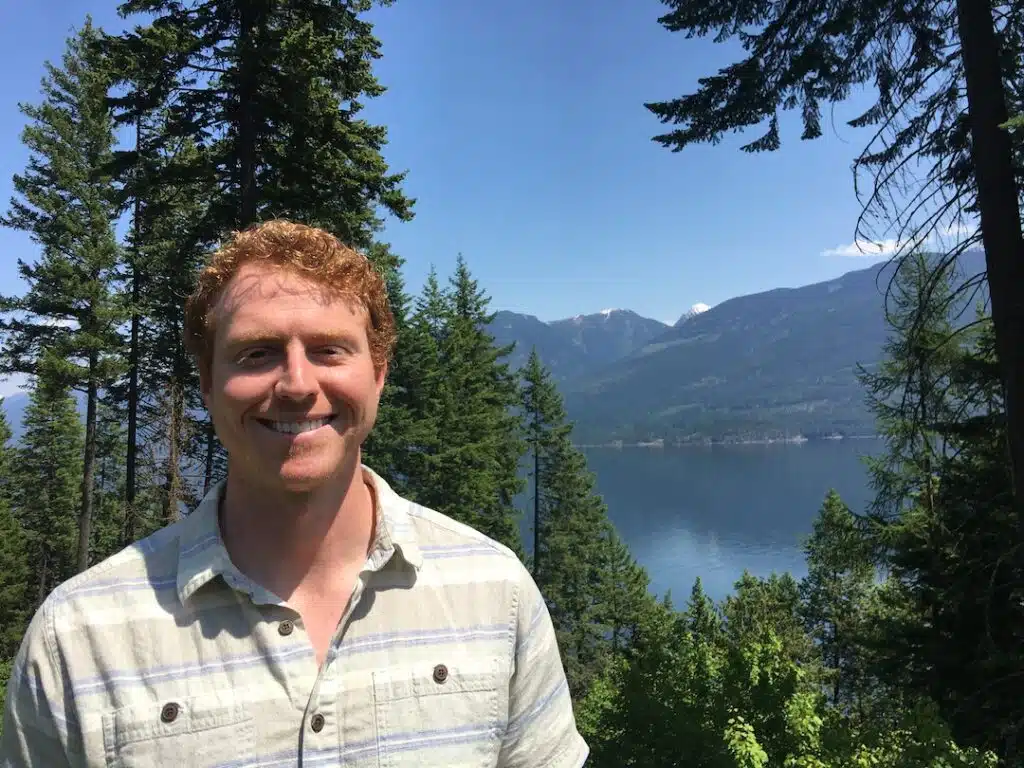
Now, almost four years later, here I am. Certainly no Zen master, but I’m incredibly proud to be doing what I am and learning every day how I can lead a more balanced, sustainable, and happy life. I’m making incremental changes—changes so small they seem trivial—but changes that stick and learning the benefit of being truly present. I’m learning how to give myself permission to be happy and how to let go of the detrimental self-narrative most of us don’t even recognize we have. A narrative that so covertly and efficiently wastes our time, zaps our energy, hinders our performance—both professionally and personally—and distracts us from being truly present with our friends, colleagues, and family. I’m learning to love and savor the moment, no matter what it may be. It’s a journey without a destination, but the trek is beautiful on its own.