In the wellness world, longevity has become the Holy Grail. Those with means are focused on biohacking their way to a longer life, optimizing every aspect of their lifestyle to add years to their lifespan. Recently, attention has been diverted away from just living longer to maximizing our quality of life as we age. What’s the point if we’re not thriving in our older years? It’s interesting because the world feels like one great dumpster fire at the moment. Increasing healthcare costs, the loneliness epidemic, the uncertainty surrounding AI, and the inevitability of climate change really don’t make living longer seem all that enticing. However, hope springs eternal.
For as long as I’m still breathing, I’d like to live a vibrant and healthy life (and do whatever I can to prevent going bankrupt due to unexpected healthcare costs). I’ve long been fascinated with the Blue Zones, regions identified by National Geographic fellow Dan Buettner and researchers as having the healthiest, long-lived populations. The five original Blue Zones are Okinawa, Japan; Sardinia, Italy; Nicoya, Costa Rica; Ikaria, Greece; and Loma Linda, CA. For anyone who understands the basics of wellbeing, it’s a fairly easy concept to grasp. There are nine principles, or lifestyle habits, that contribute to a longer life: eating a plant-based diet, moving your body regularly, having a sense of purpose, knowing how to downshift (ie: relax), prioritizing family and friends, surrounding yourself with a supportive community that encourages healthy behaviors, enjoying moderate alcohol (although foregoing alcohol altogether may prove to be even better), adopting the 80 percent rule to avoid overeating, and being part of a community that provides social connection.
While the Blue Zones have come under greater scrutiny in recent years and don’t always hold the same promise for being fountains of youth as they once were in years past, they still serve as a great reminder of the agency we all have when it comes to living a long and healthy life. Recently, I had the opportunity to take part in two Blue Zones retreats. One was set in New York City, by no means a Blue Zone, hosted by Ila Only Spa at Lotte New York Palace. There, I was introduced to retreat facilitator Céline Vadam, who led the group through a series of exercises examining the role the nine principles play in their own lives. I also experienced a restorative Immunocologie facial.
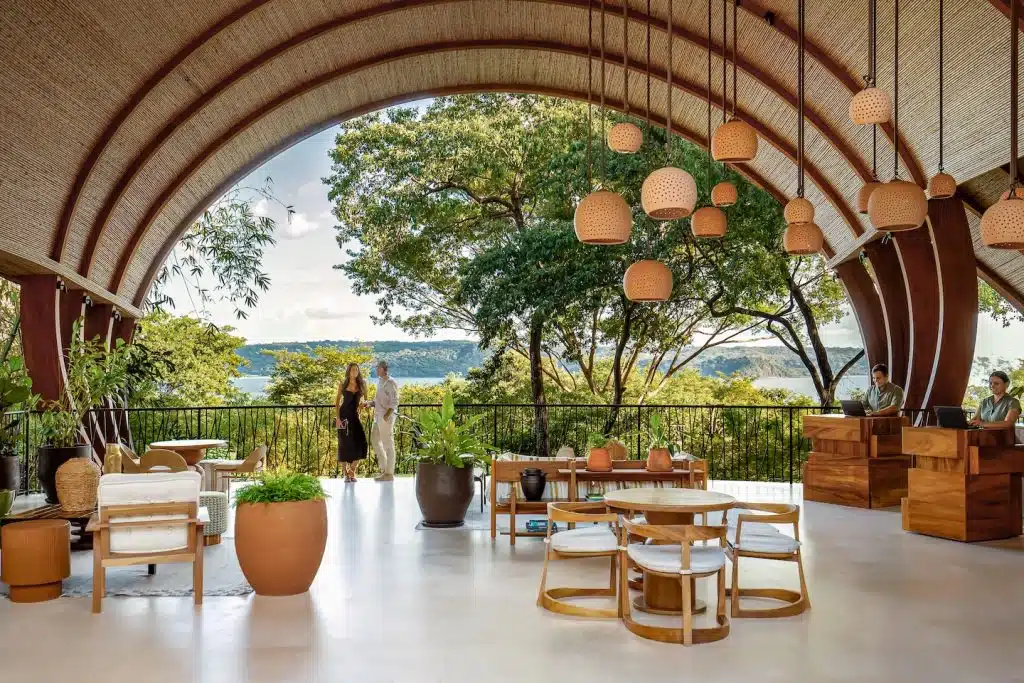
A month later, I traveled to the Papagayo Peninsula for a Blue Zones Retreat at the Andaz Peninsula Papagayo Resort. It is located just north of the Nicoya Peninsula, known as one of the five Blue Zones. There for a five-day immersive program blending workshops exploring the nine principles, movement and wellness activities, nature and cultural activities, and more, I was excited to dive into it all.
Once again, Vadam was on-hand to facilitate the retreat. Based in the Azores, she is the founder and CEO of WE(i)Think, a hospitality consulting service that specializes in wellbeing and sustainability-minded projects and a certified coach through the Institute of Integrative Nutrition. Passionate about the Blue Zones and how the knowledge gleaned from them can empower individuals to live healthier and longer lives, she created her own position as a Blue Zones Retreats and Hospitality Expert with the organization.
Spreading the word with various books, including The Blue Zones, The Blue Zones Solution, The Blue Zones Challenge, The Blue Zones of Happiness, The Blue Zones American Kitchen, and The Blue Zones Secrets, all by Buettner and the Netflix special, “Live to 100: Secrets of the Blue Zones,” the organization also partners with public and private sector leaders to enhance wellbeing using the nine principles. The retreats are yet another way to share the knowledge passed down from these destinations where longevity flourishes.

While much of the retreat revolved around group sessions that examined the nine principles and the role they played in our own lives, there were also opportunities to appreciate the resort’s stunning locale. From standup paddleboarding and kayaking to a visit to a nearby nature preserve and tours of several local farms where organic produce is grown, the retreat provided a welcome reprieve from hustle culture, complete with a morning yoga practice, an evening cacao breathing session, and a sound bath. There was even a chance to indulge in a relaxing massage at Onda Spa & Wellness.
One of my favorite activities was a hands-on coral restoration experience, in which we zip-tied coral fragments onto a wire structure. We then traveled by boat to a reef where the structures were “planted” alongside others that were already thriving. Peninsula Papagayo co-founded the Culebra Reef Gardens Alliance to help restore coral reefs in the region, which were negatively impacted by climate change.

My biggest takeaway from the Blue Zones retreat was the importance of community. In Okinawa, Japan, moais are social networks created at birth to help us thrive. Fortunately, you can create your own moais for emotional, social, and even financial support. This past year, I’ve thought a lot about community and how it impacts my own life. In the last decade or so, I don’t know anyone who hasn’t grown more dependent on the devices in their lives to communicate with others. Why in the age of connection do we all feel more disconnected than ever before?

Living in New York City, I often ride the subway. These days, it’s rare to see anyone not scrolling on their phones or wearing air pods. We have shut out the world and everyone in it. Saddened by the lack of human connection, I resolved to start prioritizing community (and NOT the online kind) and creating various moais for myself. I’m currently in a book club, which counts as one, and in a heart share group with two close friends, which I consider another.
Since the retreat, I’ve been thinking of other moais I could create, such as a walking moai that would also serve double duty and get me outside and moving. Of course, that’s the capitalist in me, raised on maximizing and optimizing productivity. If I’ve learned anything from my Blue Zones experience, it’s the opposite: to enjoy life, to slow down, and just be. I’m noticing how instinctive it still is to try and optimize even the things meant for connection and joy, and I’m gently reminding myself that they don’t need to be productive to be meaningful.
Ila Only Spa’s next Blue Zones retreat is slated for May 1-3, 2026.